Why Employer Partnership in Child Care Is Needed Now More Than Ever
Child care providers across the region are airing significant concerns while waiting to learn more about a federal funding freeze. To put it in perspective, 95% of providers and families rely on state and federal subsidies because child care simply isn’t affordable under the current broken business model. Providers AND families are scared.
The Child Care Assistance Program (CCAP) is a federal-state partnership that reduces the cost of child care for working families, allowing parents to work and go to school, ensuring children are well cared for and thrive as learners, and supporting the state’s workforce and businesses. In Minnesota alone, CCAP supports access to affordable child care for 23,000 children and 12,000 working families during an average month. In fiscal year 2024, CCAP invested $306.6 million for affordable child care for Minnesota families.
When that funding is frozen or delayed, the entire system becomes unstable. Families who cannot afford the high cost of child care tuition on their own are forced into an impossible choice: remain in the workforce or stay home with their child or children. But what if there were a way to build stability that does not rely on any single funding source?
Understanding the Three-Legged Stool
For decades, the child care field has talked about the need for a three-legged stool of sustainable funding: families, government, and employers. Just like a stool needs all three legs to stand, child care needs all three funding sources to be stable.
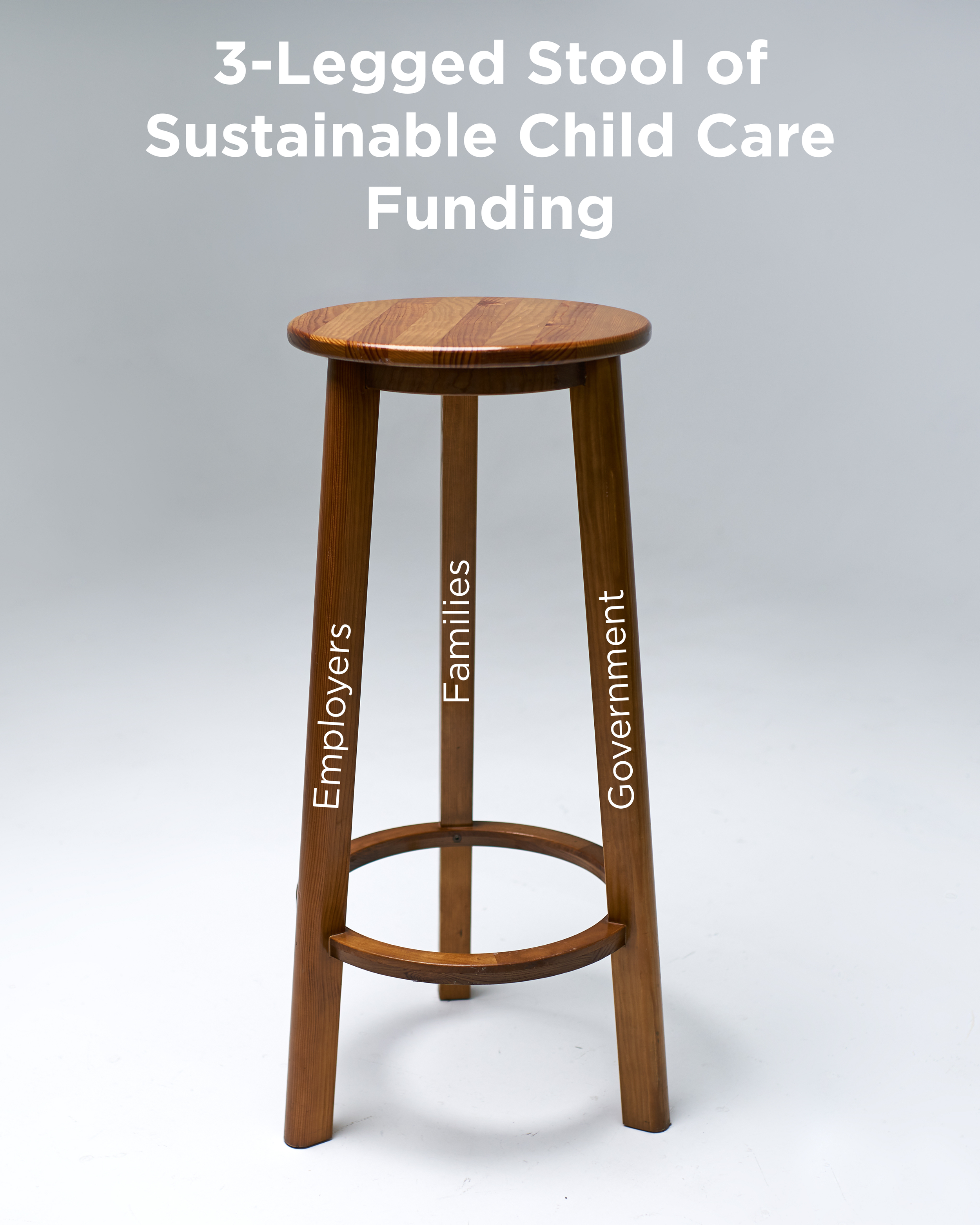
Leg 1 - Families: Tuition payments from families, kept affordable and stable
Leg 2 - Government: State child care subsidies, tax credits, and grant support
Leg 3 - Employers: Direct investment in child care operations as workforce infrastructure
For too long, the employer leg has been missing or wobbly. That’s why when government funding gets cut or delayed, the whole system falls over.
The problem is that for most of child care history, that third leg—employer investment—has been missing. When government funding freezes or families can’t afford tuition increases, providers have no buffer. They absorb losses personally, cut staff wages, or close their doors entirely.
Employer Investment Matters Now
The current federal funding uncertainty makes the case powerfully: when child care systems depend too heavily on any single funding source, they become vulnerable to disruption. But when employers enter the picture, everything changes.
At a recent House Committee on Education and Workforce hearing titled “Who’s Watching the Kids? How Employers, Innovators, and Parents Are Solving America’s Child Care,” testimony from employers across the country demonstrated the ripple effects of employer-supported child care.
“When employers enter the child care space intentionally, they can add net new supply to a community. This may include expanding capacity at existing community-based centers, developing new partnerships that create additional slots, or supporting the launch or growth of child care operations that would not otherwise be financially viable.”
The testimony reflects a wide range of employers, from very small businesses to large manufacturers. For example, Red Rooster Coffee in rural Virginia, located in a town of just 1,500 residents, is a small employer with 24 employees that offers on-site, employer-supported child care. This example sits alongside testimony from much larger organizations, underscoring that regardless of organizational size, workforce infrastructure, particularly access to child care, is critically important and benefits entire communities, not just the employees of participating companies.
As the CEO of a large manufacturer in Northeast Pennsylvania that supports its employees through near-site child care (i.e., using reserved slots with local child care centers and family child care providers) shared, “When our team members are supported, their children are supported. When child care providers in the area are supported, they have stable enrollment, can grow their businesses, and continue to thrive. That ripple effect is especially important in communities like ours.”
A Model Built for Uncertain Times: The Two-Tier Employer Partnership
The award-winning Two-Tier Employer Partnership Model, developed by Rural Pathways’ Care Solutions Division and powered by the secure TOOTRiS technology platform, treats child care as what it is: workforce infrastructure. Rather than relying on a single funding source, the model intentionally stacks and braids multiple funding streams. Here’s how the two-tier model works:
Tier 1: Employer Investment — Direct Operating Support
Direct employer investment provides predictable, flexible operating dollars to child care providers. These contributions replace unsustainable owner subsidies, support competitive wages and staff retention, and stabilize day-to-day operations. Importantly, this approach benefits all families served by the program by avoiding tuition increases that would otherwise be required to reflect the true cost of care, not only the employees of participating employers.
Beginning in 2026, employer investments are eligible for the federal Employer-Provided Child Care Tax Credit (Section 45F), allowing employers to recoup up to 50% of their contribution.
Tier 2: Family Contribution + Public Financing — Affordability and Equity
This tier combines family tuition payments (with no increases), state child care subsidies, and tax credits and strategic grant support. It preserves public participation in the child care system and ensures equitable access regardless of employment status.
The genius of this approach is its built-in flexibility during funding disruptions. When one funding stream becomes temporarily unavailable, like during the federal freeze, employer investment in Tier 1 can temporarily expand to bridge gaps in Tier 2. Families are protected from sudden tuition increases, providers avoid destabilizing revenue losses, and access to care remains continuous for working families.
This flexibility functions as a bridge strategy, not a permanent shift in responsibility. When public funding resumes, the model rebalances to its intended structure.
Proof It Works: Iron Range Tykes Learning Center
There’s promising work happening right here in Northeast Minnesota that shows this path forward. Iron Range Tykes Learning Center, for example, isn’t impacted by the federal funding freeze because they’re fully self-funded through the Gruba family and employer support.
Rural Pathways Care Solutions has helped them secure employer partners whose reserved slot fees fill in funding gaps and are gradually reducing their reliance on the Gruba family’s subsidies, proving Rural Pathways’ nationally award-winning Two-Tier Model works.
See it in Action
Shawntel Gruba has created a powerful video series called “The Part of Child Care No One Talks About” that gets direct and to the point about these issues. Watch the series to understand why this model matters and how it works in practice.
Built-In Accountability for a High-Scrutiny Environment
What makes this model different is accountability. It’s built on direct employer-to-provider contracts with 100% transparency and built-in verification. This is exactly the kind of fraud-proof approach federal auditors are demanding.
As one Representative noted during the House hearing: “Only in DC is being for a profit—a business making money—or a for-profit attitude a bad thing. Solutions will come from the for-profit sector; that’s where the innovation comes from.”
Profitability isn’t a negative outcome; it signals stability. It means the model works, it can endure, and it is positioned to last.
Building a Regional Safety Net
Rural Pathways has been building what we’re calling a regional “safety net” to protect local providers and workforce. We work with nearly a dozen child care centers and providers across Northeast Minnesota.
We’re also part of the Iron Range Taskforce, a coalition that includes the Iron Range Resources and Rehabilitation Board (IRRRB), Range Association of Municipalities and Schools (RAMS), local economic development authorities, and regional chambers of commerce. This group is currently funding an action-oriented policy brief and regional data report due in late March.
Community forums are planned for Silver Bay, Grand Rapids, and Chisholm, Minnesota, this spring to share information and help regional employers implement this new model.
The Time to Act Is Now
Rather than waiting for a federal thaw, we’re building a bridge to a more sustainable, private-pay foundation. The expanded Section 45F tax credit (now offering up to 50% back on qualified child care expenditures for small businesses) makes employer investment more attractive than ever.
Child care is a uniquely “sticky” benefit for employers. As testimony at the House hearing noted: “While higher wages and signing bonuses can influence recruitment in the short term, child care support directly addresses a structural barrier to workforce participation. When workers have reliable child care in place, they are able to show up consistently and fully engage in their roles. That stability benefits entire teams, not just individual families.”
Resources to Get Started
House Committee on Education and Workforce Hearing (January 13, 2026): “Who’s Watching the Kids?”
New child care tax incentives overview (Section 45F)
“The Part of Child Care No One Talks About” video series by Shawntel Gruba
Ultimately, this is about securing our child care infrastructure, which is just as vital to our current and future workforce as broadband and housing. The three-legged stool has been wobbling for too long. It’s time to strengthen that third leg.
Ready to build your third leg?
Rural Pathways can help.
We work with rural nonprofits to diversify revenue streams, build corporate partnership strategies, and create sustainable funding models. Whether you’re just getting started or looking to strengthen your approach, we’re here to guide you through every step.
Contact us to schedule a discovery call.